The 5 best air purifiers for UK homes in 2026
Comparing air purifiers for a family home? These five picks cover bedrooms, nurseries, allergies, room size, noise at night and filter upkeep.
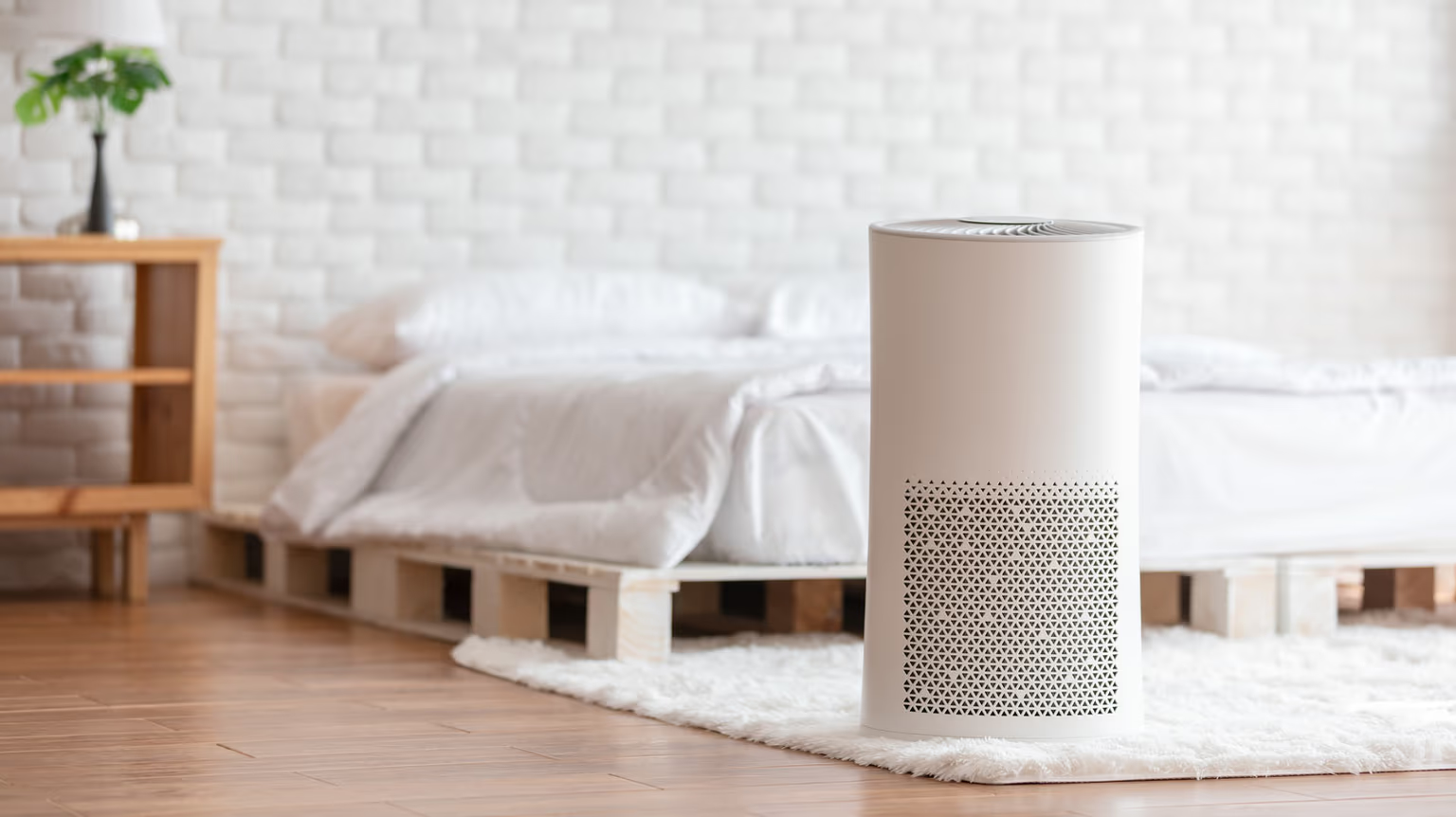
The right air purifier depends less on one headline claim and more on where it will run every day: a compact nursery, a bedroom during hay fever season, a living room with pets, or a larger open-plan space. Before choosing, compare room-size guidance, HEPA and carbon filtration, noise at night, filter replacements and whether the unit can be kept out of reach of curious hands.
Criteria | |||||
|---|---|---|---|---|---|
| Best for | Best for Compact value | Smart allergy tracking | Larger family rooms | Quiet bedrooms and nurseries | Premium open-plan spaces |
| Room fit cue | Room fit cue Up to smaller or mid-size rooms | Sensor-led everyday rooms | Higher CADR, larger-room role | Up to mid-size bedrooms | Large rooms and open-plan areas |
| Night use | Night use Ultra-quiet positioning | Auto sleep mode | Sleep and auto mode | Quiet-first positioning | Ultra-quiet positioning |
| Controls | Controls App control | App, Alexa and air-quality sensor | Smart sensor and auto mode | Smart WiFi | Intelligent controls |


How to choose an air purifier for a family home
Start with the room where the purifier will spend most of its time. A smaller bedroom or nursery does not need the same capacity as an open-plan living area, and an oversized unit may only be worth it if you will run it on a lower, quieter setting.
- Match the manufacturer's room-size guidance to the actual room, allowing extra capacity for open-plan spaces or high ceilings.
- Choose HEPA-style particle filtration for pollen, dust and pet dander, and look for activated carbon if odours, smoke or VOCs are part of the problem.
- Check sleep mode, low-speed noise and display lights if the purifier will run near a cot or bed.
- Look for child lock, stable placement and simple controls if toddlers may reach the unit.
- Check filter cost, availability and replacement reminders before buying, because a clogged filter will not perform as intended.
The best air purifiers for UK homes
These five picks cover different family-home needs rather than pretending one unit is perfect everywhere. Use the product roles as a shortcut, then check the room-size and maintenance details before you click through.
1. Philips 600 Series Air Purifier

The Philips 600 Series is the most straightforward pick if you want a compact purifier from a well-known brand without jumping straight to a large living-room unit. It suits smaller bedrooms, nurseries and flats where easy placement, quiet running and filter upkeep matter more than maximum capacity.
Why did we choose this product?
It is a sensible first look because it balances a recognisable brand, compact-room coverage and easy everyday controls. With a stated room-size claim of up to 44 m², HEPA filtration, app control and quiet, energy-efficient operation, it is practical for family rooms that are not especially large.
Keep in mind
Do not buy it expecting one small purifier to clean a whole home or a large open-plan room. For bigger spaces, the WINIX or Philips 3200 will make more sense. As with any purifier, check the replacement-filter cost before committing.
Features that may help you
•Good fit for smaller bedrooms, nurseries and compact living spaces
•Manufacturer room-size claim: up to 44 m²
•HEPA filtration for pollen, dust and other everyday airborne particles when sized correctly
•App control for checking or changing settings without disturbing sleep
•Marketed for quiet, energy-efficient running
•Popular compact option with strong recent demand
2. Levoit Core 300S Smart HEPA Air Purifier

The Levoit Core 300S is the pick for parents who want smart controls and air-quality feedback, especially in an allergy-prone bedroom or living space. It is more feature-rich than a simple compact purifier, but still feels manageable for everyday family use.
Why did we choose this product?
The standout reason to choose it is convenience. Its laser air-quality sensor, auto sleep mode, app control and Alexa support are useful if you want the purifier to react to the room rather than needing constant manual changes. It also has plenty of owner feedback behind it, which adds reassurance for a smart model.
Keep in mind
It is only worth paying for the smart features if you will actually use them. If you prefer one-button simplicity for a small room, the Philips 600 or Blueair may feel simpler. Avoid treating the large room-size headline as a guarantee for every layout; open doors and high ceilings can change performance.
Features that may help you
•Smart HEPA purifier for bedrooms and everyday family spaces
•CADR listed at 258 m³/h
•Manufacturer room-size claim: up to 108 m²
•Laser air-quality sensor with automatic and sleep modes
•App and Alexa control
•Useful in homes where pollen, dust and odours are concerns, when sized correctly
3. WINIX 5500-2 Air Purifier

The WINIX 5500-2 is the stronger choice for a living room, main bedroom or busier family space rather than a small nursery corner. It offers more capacity than the compact models and has a long track record of owner feedback.
Why did we choose this product?
It is appealing when you want more airflow headroom. Its stated CADR is 390 m³/h, with a room-size claim up to 99 m², carbon and HEPA filtration, smart sensor behaviour, sleep mode and auto mode. That combination is useful for homes dealing with pets, pollen, smoke or everyday airborne particles in a bigger room.
Keep in mind
This is not the first choice for a nursery. If you plan to use it near a baby or toddler, check the manual for PlasmaWave or ionisation-style settings and use a filter-only mode if one is available. It is also more purifier than many small bedrooms need.
Features that may help you
•Best fit for larger family rooms and busier shared spaces
•CADR listed at 390 m³/h
•Manufacturer room-size claim: up to 99 m²
•Carbon and HEPA filtration
•Smart sensor, sleep mode and auto mode
•Long-established model with extensive owner feedback
4. Blueair Blue 511i Max Smart WiFi Air Purifier

The Blueair Blue 511i Max is the shortlist's bedroom and nursery option. It is the one to consider if quiet running, a softer-looking compact design and smart WiFi control matter more than maximum room coverage.
Why did we choose this product?
It gives parents an alternative to Levoit for quiet rooms, smaller bedrooms and nurseries. With a stated room-size claim of up to 43 m² and Blueair's HEPASilent dual-filtration claim, it is well suited to bedrooms.
Keep in mind
Keep the claims realistic. It may help reduce airborne particles in the room where it is running, but it should not be treated as medical protection or as a mould fix. Check replacement-filter availability before buying, especially if you plan to run it nightly.
Features that may help you
•Best fit for quiet bedrooms and nurseries
•Manufacturer room-size claim: up to 43 m²
•Blueair's HEPASilent dual-filtration claim
•Smart WiFi control
•Compact option for pets, allergies, dust, smoke and odours when used in the right room
•Strong fit for parents who prioritise night-time comfort
5. Philips 3200 Series Air Purifier

The Philips 3200 Series is the premium-capacity pick for families with a larger room, open-plan layout or greater airflow needs. It is the model to look at when compact bedroom purifiers feel underpowered for the space.
Why did we choose this product?
Its main advantage is capacity. Its stated CADR is 520 m³/h, with a room-size claim up to 135 m², HEPA NanoProtect and active carbon filtration. That makes it a better fit for open-plan family spaces, pets, smoke or odours than a small bedside purifier.
Keep in mind
This is the one most likely to be overkill for a small nursery or occasional bedroom use. Check the physical size, filter cost and where it will sit before choosing it over a smaller Philips or Blueair model.
Features that may help you
•Premium-capacity option for larger rooms and open-plan spaces
•CADR listed at 520 m³/h
•Manufacturer room-size claim: up to 135 m²
•HEPA NanoProtect plus active carbon filtration
•Marketed for ultra-quiet running and intelligent controls
•Better for bigger spaces than compact bedside use
What an air purifier can and cannot fix
Allergies, hay fever and everyday particles
An air purifier can be useful when pollen, dust, pet dander or smoke make a room less comfortable, especially if you run it regularly and choose a model sized for the room. It is still a support tool, not a cure for asthma or allergies, and it cannot fix poor indoor air on its own.
Basic indoor-air habits still matter: ventilate when outdoor pollen and pollution conditions allow, keep the home smoke-free, dust and vacuum regularly, and deal with obvious sources of pollution rather than expecting the purifier to do everything.
Mould, damp and ventilation limits
Air purifiers may help reduce some airborne particles and musty odours, but they do not fix damp walls, condensation, leaks or mould growth. For those problems, moisture control and ventilation come first.
If condensation, drying laundry indoors or damp rooms are the main issue, a purifier may be the wrong first purchase. Our best dehumidifiers for homes cover that separate moisture problem more directly.
Ozone, ionisers and caution in nurseries
For nurseries and bedrooms, a physical filter-based purifier is the simpler starting point. UK childcare guidance favours HEPA air-cleaning units where air cleaning is needed and does not recommend ozone generators or ionisers for those settings.
That does not mean every extra feature is dangerous, but it does mean parents should read the manual, avoid intentional ozone-producing products, and be cautious with ionising or UV-style features around babies and children.
Setup, filters and running costs
Where to put it in a nursery or bedroom
Place the purifier where air can move freely around it, not jammed behind furniture or pressed right against curtains. Keep cables tidy, avoid putting the unit where a child could pull it over, and keep it out of reach of babies and toddlers.
For the wider room setup, pair purifier placement with basic baby-proofing checks around cords, sockets, stable furniture and anything a child could climb or grab.
How often filters need changing
Filter life depends on the model, pollution levels in the room and how often the purifier runs. A replacement reminder is useful, but it is still worth checking the manual and making sure the filter is seated properly after every change.
Running a purifier on a very low setting can be quieter, but it also moves less air. If the room feels stuffy or the air-quality sensor keeps reacting, a larger unit on a low setting may be more comfortable than a small unit working hard.
When a bigger unit is worth it
Choose a higher-capacity purifier for open-plan layouts, large bedrooms, pets, smoke exposure or rooms where doors are often open. For a small nursery or occasional bedroom use, a compact model may be easier to place, quieter to live with and cheaper to maintain.