
Baby temperature: what's normal and when a fever needs help
A baby's normal temperature is about 36.4C and a fever is 38C or more. Under 6 months the number alone can mean getting help now; later, how your baby seems matters more.
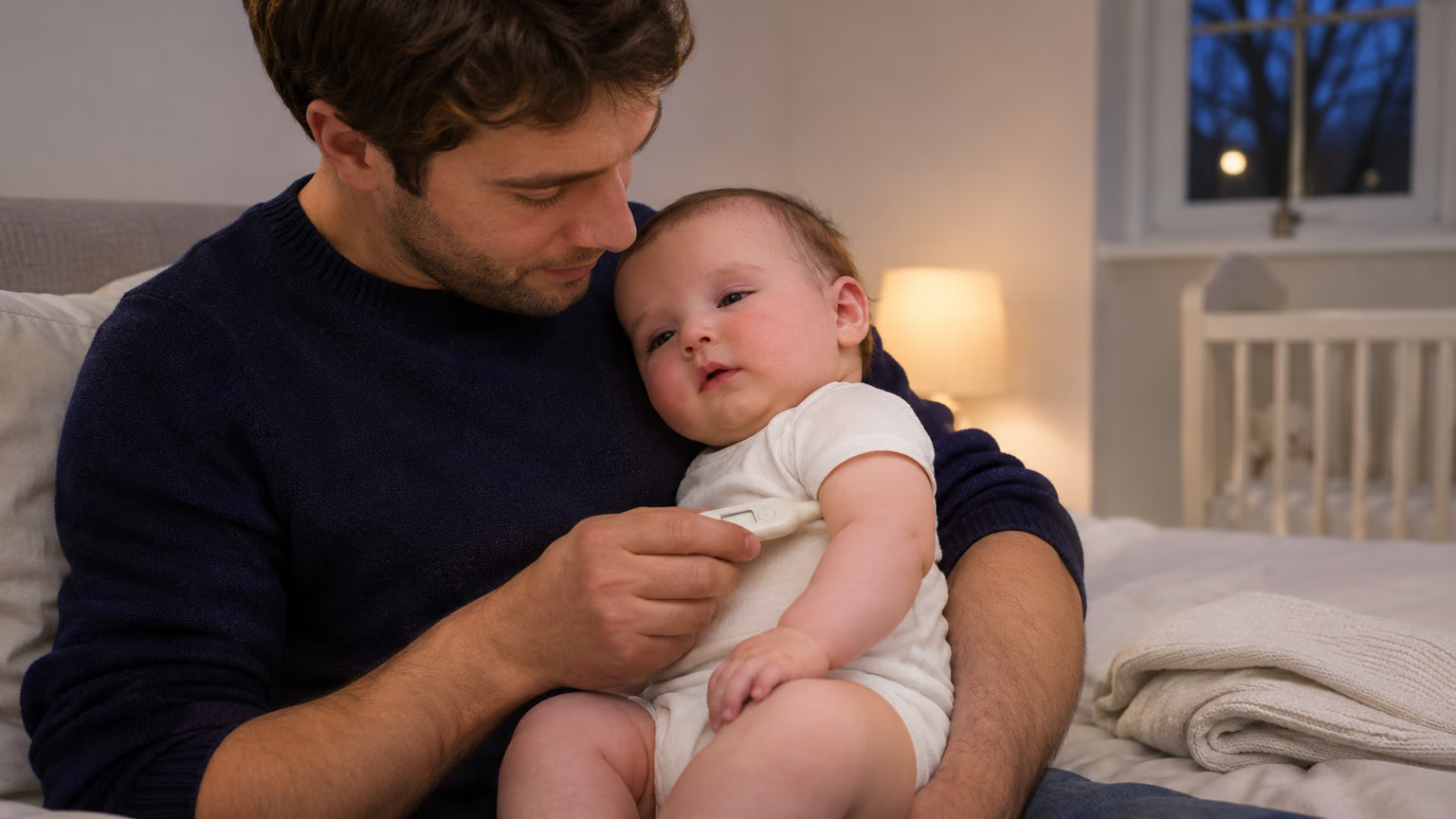
A typical baby temperature is about 36.4C, but every baby runs a little warmer or cooler, so the lines that matter are 38C or more, a high temperature, and below 36C, a low one. Those numbers are for a digital thermometer under the arm, which is how the NHS asks you to check any child under 5. Most high temperatures are the body fighting an infection such as a cold, and they usually settle within 1 to 4 days.
In young babies the number alone can decide how quickly to act, so the thresholds in the box below are worth knowing before you need them. From about 6 months, how your baby seems tells you more than the reading: a baby who is feeding, alert and responding to you is less likely to be seriously ill than one who is floppy or hard to wake, even at the same reading.
What's a normal temperature for a baby or newborn?
Newborns follow the same numbers as older babies and young children: about 36.4C is typical, 38C or more is high and below 36C is low. A reading in between, such as 37.2C or 37.5C, isn't a fever. The chart shows where readings fall, in Celsius and in Fahrenheit in case your thermometer uses it.

How to get a reading you can trust
Use a digital thermometer under the arm. It's the only method NICE recommends for babies under 4 weeks. From 4 weeks an ear thermometer is an option too, but the NHS warns that ear readings can mislead if the tip isn't placed properly, which is easy to get wrong in a small ear. Forehead strips aren't accurate, and readings from the mouth or bottom aren't recommended for children under 5.
Sit your baby on your knee, put the tip in the top of their armpit against the skin, and hold their arm gently against their side for as long as the leaflet says, usually about 15 seconds.
A reading can be briefly higher if your baby has just had a bath, been wrapped up snugly or been very active, has cuddled a hot water bottle, or is wearing a lot of clothes or in a very warm room. Let them cool down for a few minutes, without getting cold or shivery, then check again. If an ear or forehead thermometer gives a reading that worries you, check it under the arm. And don't let a recheck delay help if your baby seems very unwell.
If you're choosing a thermometer, our guide to the best baby thermometers compares underarm sticks with ear and forehead models.
What a low temperature means in a newborn
A temperature below 36C can be a sign of serious illness in babies and young children, so take it as seriously as a high one. Check it 2 more times within 10 minutes. If it stays below 36C, or your baby feels cold to touch or is shivery, call 999 or go to A&E. A baby with a very low temperature may also seem unusually quiet or sleepy, or breathe slowly with small breaths.
When to worry about a baby's temperature
The table puts the NHS age thresholds in one place. NICE, whose guidance doctors use, counts 38C or more in a baby under 3 months as a high-risk sign on its own.
Age and reading | What to do |
|---|---|
| Under 3 months, 38C or more | Get medical help now |
| 3 to 6 months, 39C or more | Get medical help now |
| 3 to 6 months under 39C, or over 6 months | Care at home if they seem well |
| Any age, 38C or more for 5 days | Call 111 or your GP |
| Any age, below 36C on recheck | Call 999 or go to A&E |
In England, the NHS guide to urgent help for under-5s lists both under-6-month readings under call 999 or go to A&E. Some older NHS pages say call 111 for them instead; either way, get help straight away. If you think a baby under 6 months has a high temperature but you can't take a reading, call 111.
If your baby had vaccinations in the past 2 days, a high temperature is a common reaction, especially after the MenB jabs at 8 and 12 weeks. For those readings, the NHS vaccine pages say ask for an urgent GP appointment or call 111, and the MenB page says to do the same if a high temperature lasts more than 48 hours after the jab. Any of the warning signs below still means 999. Our baby vaccination schedule has the paracetamol plan for those jabs.
Call 999 or go to A&E for these signs
Whatever the thermometer says, get emergency help if your baby:
- has difficulty breathing, is breathing very fast, makes grunting noises or sucks in their tummy under the ribs
- has blue, grey, pale or blotchy skin, lips or tongue (on brown or black skin, this can be easier to see on the palms and soles)
- has a rash that doesn't fade when you press a glass against it
- has a stiff neck or seems bothered by light
- has a fit
- is floppy, drowsy and hard to wake, or isn't responding the way they normally do
- has a weak, high-pitched or continuous cry, or is very agitated and won't settle
- has skin that feels cold or clammy, or unusually cold hands and feet
- has swollen lips, tongue or throat and difficulty swallowing
- hasn't had a wet nappy in the past 12 hours
If you feel something is seriously wrong, trust your instincts and get help.
When to call 111 or your GP
Get urgent advice from 111 or your GP if your baby:
- has a high temperature and other signs of illness, such as a rash
- has had a high temperature for 5 days or more
- isn't feeding, or isn't their usual self and you're worried
- shows signs of dehydration, such as fewer wet nappies, sunken eyes or no tears when crying
- isn't helped by paracetamol or ibuprofen
For a child under 5, phone 111 rather than using 111 online.
Scotland, Wales and Northern Ireland
The emergency signs are much the same across the UK, but the route for a high reading differs a little:
- Scotland: NHS inform says phone 999 or go to A&E for a baby under 3 months with 38C or more, or 36C or less, unless they had a vaccination in the past 2 days. Over 3 months, 39C or more means contacting your GP practice, or 111 when it's closed.
- Wales: NHS 111 Wales says call 111 or your GP surgery now for 38C or more under 3 months, or 39C or more at 3 to 6 months.
- Northern Ireland: nidirect says contact your GP urgently for those readings, or the GP out-of-hours service when the surgery is closed.
Can teething or overheating cause a high temperature?
Does teething cause a fever?
Teething can make your baby slightly warmer, but the NHS puts that rise below 38C. A reading of 38C or more isn't a teething symptom, so treat it as a high temperature and use the age guide above. Other signs of a new tooth include red, sore gums, one flushed cheek, more dribbling, chewing on everything and more unsettled nights. For soothing sore gums, see our pick of teething toys for babies.
Too warm, or a fever?
Too many clothes or blankets, or a hot room, can push a baby's temperature up. If your baby has been bundled up, take off the extra layer, wait a few minutes and check again. If the reading is still 38C or more once they're dressed for the room, treat it as a high temperature.
To check day to day that your baby isn't too hot, feel their chest or the back of their neck: if the skin is hot or sweaty, remove a layer of clothing or bedding. Cool hands and feet are normal. Keep the room at 16 to 20C, take hats off indoors, and never let your baby sleep with a hot water bottle or electric blanket, next to a radiator or heater, or in direct sunlight. Overheating raises the risk of sudden infant death syndrome (SIDS). Our baby sleeping bag TOG guide matches layers to the room.
How to look after a baby with a high temperature
If your baby doesn't need help now for their age and has none of the warning signs, you can usually look after them at home while the temperature comes down over the next few days:
- Offer plenty of fluids: keep breastfeeding as normal, or give formula little and often, plus food if they want it.
- Watch for dehydration: fewer wet nappies, a sunken soft spot on top of the head, sunken eyes, few or no tears, or being drowsy or irritable.
- Dress them for the room. Don't undress them or sponge them down to cool them, and don't pile on extra clothes or blankets.
- Check on them regularly, including during the night.
- Keep them home from nursery while the high temperature lasts, and let the nursery know they're ill.
However tired you both are, never fall asleep with an unwell baby on the sofa, as it raises the risk of SIDS.
Paracetamol and ibuprofen for babies
Medicine is for a baby who is distressed or uncomfortable. It isn't needed just to bring the number down, and a temperature that falls after a dose doesn't show that an illness isn't serious. Neither medicine prevents febrile seizures.
- Paracetamol: not under 2 months. At 2 to 3 months, only if your baby was born after 37 weeks and weighs over 4kg, and usually no more than 2 doses in a day. The 3-dose plan after the MenB jabs is the exception.
- Ibuprofen: not under 3 months or under 5kg, or if your baby has chickenpox or is dehydrated. With asthma, only if a doctor recommends it.
- Don't give both at once, and only alternate them if a doctor or nurse tells you to.
- Never give aspirin to anyone under 16.
Use the syringe or spoon that comes with the medicine and the dose on the pack for your baby's age, and ask a pharmacist if you're not sure. If you've given more than the pack says, call 111.
Febrile seizures: what to do if your baby has a fit
A febrile seizure is a fit brought on by a high temperature. It usually happens between 6 months and 6 years and lasts 2 to 3 minutes. It's frightening to watch, but it's unlikely to harm your baby or have lasting effects, and there's nothing you could have done to prevent it.
While it's happening:
- note the time it starts and stops
- protect their head with your hands or something soft, and move anything dangerous out of the way
- don't hold them down or put anything in their mouth
- don't try to cool them by undressing them or sponging them with cold water
- when it stops, put them in the recovery position and check nothing in their mouth could block their breathing; for a baby under 1, St John Ambulance shows how to cradle them in your arms with their head tilted down
Call 999 or go to A&E if it's your baby's first febrile seizure, or if a seizure lasts more than 5 minutes, they have difficulty breathing, the stiffness or twitching affects only one side of the body, they're more sleepy than usual for more than an hour afterwards, or they have more than one seizure in 24 hours. If they're still fitting or unconscious, call 999 rather than driving to A&E. After a first febrile seizure, your baby will need to be checked in hospital.
Frequently asked questions
References:
- NHS: How to take your baby's temperature
- NHS: High temperature (fever) in children
- NHS: When to get urgent medical help for babies and children under 5
- NICE NG143: Fever in under 5s
- NHS: Febrile seizures
- NHS: Baby teething symptoms
- NHS: Paracetamol for children
- NHS: Ibuprofen for children
- NHS: MenB vaccine for children
- The Lullaby Trust: Your baby's room temperature
- NHS inform: Fever in children
- NHS 111 Wales: Fever in children
- nidirect: Fever in children


