
The 5 best baby sleeping bags of 2026
Five baby sleeping bags compared, from 2.5 TOG newborn bags to toddler sizes, plus how to pick the TOG and when a pillow or duvet can come in.
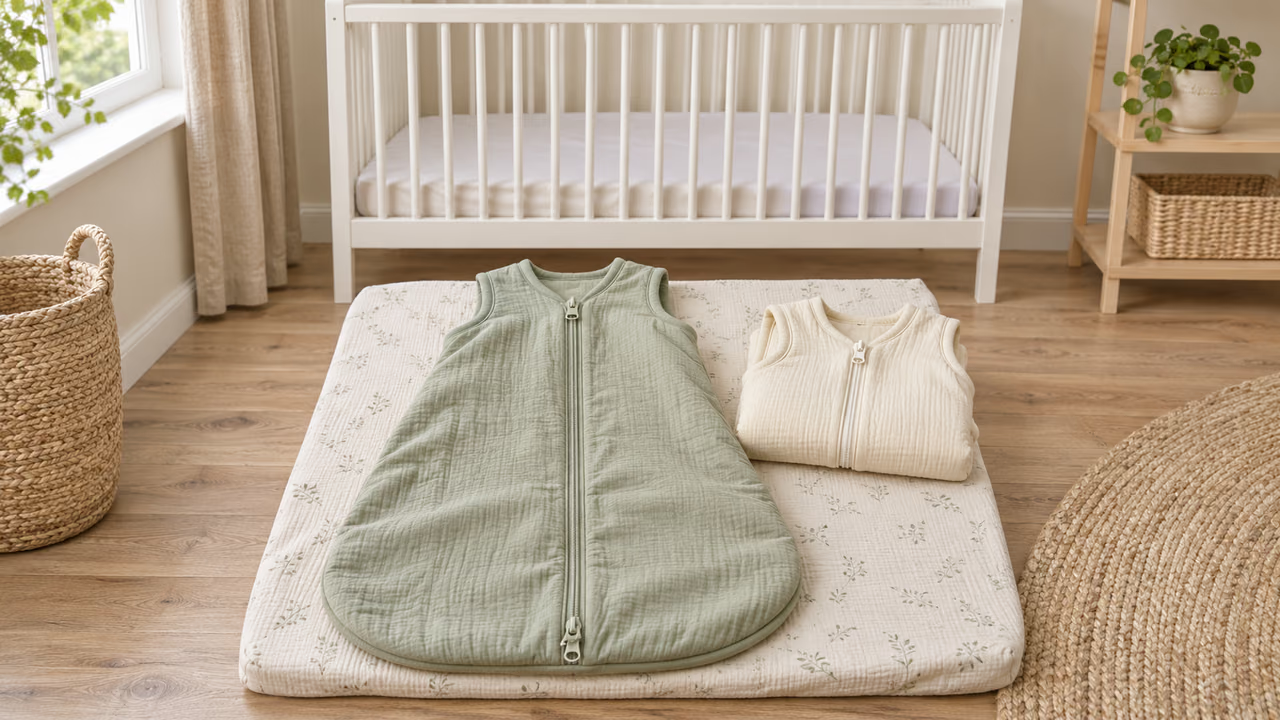
A baby sleeping bag takes the place of loose cot bedding. Your baby can't wriggle down under it or kick it off, and it keeps them warm without a pillow or duvet, neither of which belongs in the cot before their first birthday.
Choosing one comes down to three things: a TOG that suits the room your baby sleeps in, a size that fits snugly at the neck and armholes, and enough bags to cover the wash. In a nursery kept at the recommended 16–20°C, that usually means a 2.5 TOG bag for most of the year and a lighter one for hot spells, with toddler sizes for later.
Criteria | |||||
|---|---|---|---|---|---|
| Best for | Best for Most babies in a standard nursery | One bag for changing temperatures | Warm bag on a budget | Toddlers up to 36 months | Hot rooms and summer |
| TOG | TOG 2.5 TOG | 2.5 or 1.0 TOG | 2.5 TOG | 2.5 TOG | 0.5 TOG |
| Room temperature | Room temperature 16–20°C | 16–24°C | 16–20°C | 16–20°C | 24–27°C |
| Size in this pick | Size in this pick 0–6 months | 0–6 months | 0–6 months | 18–36 months | 0–6 months |
| Useful detail | Useful detail Curved nappy zip | Removable warm layers | Quilted with fleece filling | Adjustable length | Pack of two |


What TOG baby sleeping bag do you need?
Pick the TOG for the room, not the month. The NHS gives this guide for baby sleeping bags:
- 2.5 TOG for standard rooms of 16–20°C, all year round
- 1.0 TOG for warmer rooms of 20–24°C
- 0.5 TOG for hot rooms of 24–27°C
The NHS and the Lullaby Trust recommend keeping your baby's room at 16–20°C, so a 2.5 TOG bag is the one most parents need first, with a 0.5 or 1.0 TOG bag for heatwaves. A room thermometer takes the guesswork out of it, and some baby monitors show the room temperature too. Our guide to the ideal room temperature for a baby has more detail.
If the room drops below 16°C, add a layer under the bag, such as a long-sleeved sleepsuit, or move up to a warmer bag if your baby still feels cold. Never put a blanket or duvet on top. To check your baby, feel their chest or the back of their neck: if it's hot or sweaty, take a layer off. Cool hands and feet are normal.
Then check the size. Most baby sleeping bags are sized by weight or height, so treat the age on the label as a rough guide. The Lullaby Trust says to wait until your baby weighs at least 4 kg before using a sleep bag, so a newborn under that weight needs firmly tucked blankets instead.
The best baby sleeping bags of 2026
Our first pick suits most babies in a standard nursery. The others cover a bag that adapts to the room, a budget bag, toddlers and hot summer nights. Check the exact size and TOG before you buy, as one listing often holds several.
1. SnuzPouch 2.5 TOG baby sleeping bag

The SnuzPouch is the baby sleeping bag we'd suggest to most parents. The 2.5 TOG version suits the 16–20°C the NHS recommends for a baby's room, and the 0–6 months size is where to start once your baby is big enough for a sleeping bag.
Why did we choose this product?
Its standout feature is the curved nappy zip, which opens across the front so you can change a nappy at night without taking the whole bag off. Owners often single it out, along with soft cotton that washes well and lasts through more than one baby. Poppers help adjust the fit, and the listing says it meets the British safety standard for sleeping bags.
Keep in mind
It costs more than most bags here, and the 2.5 TOG is too warm for a hot bedroom, where you'd need Snuz's 1 TOG version or a lighter bag. The 2.5 TOG comes in 0–6, 6–18 and 18–36 months, so check your baby against the size guide rather than going by age alone.
Features that may help you
•2.5 TOG for rooms of about 16–20°C
•Curved zip for night-time nappy changes
•Poppers to adjust the fit
•Cotton outer with a soft filling
•Sizes from 0–6 up to 18–36 months; 1 TOG versions too
2. Tommee Tippee All-Season Grobag

If your baby's room changes with the weather, or you'd rather buy one bag than two, the All-Season Grobag is the one to look at. It's 2.5 TOG with its padded layers on and 1.0 TOG with them off, so it covers both the standard and the warmer room bands.
Why did we choose this product?
You can zip and pop the warm layers off while your baby sleeps rather than changing the whole bag, which owners find handy for travel and changeable nights. Breathable mesh sits where babies run hot, the bag is slim through the chest and roomy at the hips, and poppers on the armholes of the 0–6 months size help a smaller baby fit.
Keep in mind
The zips and layers take a few nights to get used to. It's made for arms-out sleep, not swaddling. Check the room temperature and your baby's chest rather than relying on the all-season label.
Features that may help you
•2.5 TOG, or 1.0 TOG with the padded layers removed
•Warm layers come off without undressing your baby
•Mesh panels in the warmest spots
•Armhole poppers for a smaller baby
•0–6 months size in cotton-rich jersey
3. Unnivoll 2.5 TOG quilted baby sleeping bag

Unnivoll's quilted bag is the cheapest 2.5 TOG baby sleeping bag in this list, and one of Amazon's best-selling baby sleeping bags at the moment. It's a simple sleeveless bag for cooler rooms, with a cotton outer and a soft fleece filling.
Why did we choose this product?
It makes sense as a first winter bag on a budget, or as the spare for when the main one is in the wash. The two-way zip opens from the bottom for nappy changes and has a guard at the chin. Owners say it's soft, properly warm on cold nights and keeps its shape in the wash.
Keep in mind
It's thick, so it takes longer to dry, and it's not the bag for a warm room. Some owners say it comes up small, so check the length against your baby's height and make sure the neck and armholes sit snugly before you choose a size.
Features that may help you
•2.5 TOG for rooms of about 16–20°C
•Quilted cotton outer with fleece filling
•Two-way zip with chin guard
•Roomy at the legs
•Sizes 0–6, 6–12, 12–18 and 18–24 months
4. Lictin 2.5 TOG toddler sleeping bag

For an older baby or toddler, Lictin's 18–36 months bag has the room that newborn-led ranges run out of. The length adjusts to fit children of about 90 to 110 cm with fastening tabs on the back, and the 2.5 TOG filling suits cooler bedrooms.
Why did we choose this product?
It's an easy way to keep a toddler in a sleeping bag well past the first birthday. Owners like the generous leg room and say it washes well without shrinking, and two zips let you get to the feet or the nappy without taking the bag off.
Keep in mind
The fabric isn't the softest, the length tabs can work loose on a wriggly toddler, and owners are split on the double zips, which some find bulky. Measure your child's height and neck before you buy. Lictin also says to stop using the bag once your child can climb out of the cot.
Features that may help you
•2.5 TOG toddler sleeping bag
•18–36 months, about 90–110 cm tall
•Adjustable length with tabs on the back
•Two zips for nappy changes
•Cotton fabric and filling
5. PewinGo 0.5 TOG summer baby sleeping bag

For heatwaves and warm flats, PewinGo's two-pack of 0.5 TOG bags is the lightweight option. They're thin organic cotton, made for rooms of 24–27°C, and the 0–6 months size fits babies of about 57–67 cm and 4–8.3 kg.
Why did we choose this product?
Two bags in the pack means one can be in the wash, and owners say they stay soft and keep their shape after plenty of washes. The two-way zip has a guard at the chin, and the bag is roomy at the hips and legs.
Keep in mind
It's very light, so it's only for genuinely warm rooms; in a standard 16–20°C nursery you'd want a 2.5 TOG bag. Go by height and weight rather than age, as owners are split on the fit: some find it short, others too roomy at the neck and armholes for a small newborn, so make sure those sit snugly.
Features that may help you
•0.5 TOG for rooms of about 24–27°C
•Pack of two
•Organic cotton
•Two-way zip with chin guard
•0–6 months: about 57–67 cm and 4–8.3 kg
How to use a baby sleeping bag safely
Check the fit as your baby grows
A well-fitted bag sits snugly around the neck and shoulders so your baby's head can't slip down inside, with proper armholes, no hood and no spare fabric around the face. Recheck the fit as your baby grows and move up a size when they reach the top of the size guide.
Look for BS EN 16781:2018, the British Standard for baby sleeping bags, on the label or listing, and ask the seller if it isn't clear. It shows the bag itself has passed safety tests, but it isn't a SIDS standard, so the right size, TOG and a clear cot still matter. Our baby sleeping bag safety, fit and TOG guide walks through the checks.
Nothing on top, and nothing weighted
Use the bag on its own in a clear cot: no blankets, duvets, pillows, cot bumpers or soft toys, and no hat indoors.
Washing and night changes
Two bags, or a two-pack, means one can be in the wash while the other is in use. Zips that open from the bottom make night-time nappy changes quicker, and a dim night light helps you see what you're doing without fully waking your baby; keep it outside the cot. Follow each bag's washing label, and remember that thick 2.5 TOG bags take longer to dry.
When can a baby sleep with a pillow or duvet?
Not before 12 months. The NHS says not to use pillows or duvets with babies under one, and the Lullaby Trust lists pillows, duvets and quilts among the bedding to avoid. That covers naps as well as nights. If your baby was born prematurely, count the 12 months from their due date, not their birthday.
Why pillows and duvets have to wait
A young baby can't push a duvet off their face, and a pillow puts soft material right where they breathe. Soft, bulky bedding can also make a baby too hot, and the Lullaby Trust says quilts, pillows and duvets have been shown to triple the risk of SIDS. A thin pillow or a light cot quilt still counts, and rolling or sitting up doesn't bring the date forward. Cot duvet and pillow sets are easy to find, and some are even described as suitable for newborns, so don't take the packaging as permission.
A pillow won't help with reflux or a flattening head either. Keep your baby flat on their back on a flat mattress, and don't prop up the cot or mattress: the Lullaby Trust says it doesn't help reflux. Speak to your GP or health visitor if reflux worries you. For a flat spot, give plenty of supervised tummy time while your baby is awake, and ask a health professional if it looks severe.
What to use instead
Until the first birthday, use one of two setups in your baby's own cot, Moses basket or bedside crib, on a firm, flat mattress:
- A baby sleeping bag that fits snugly around the neck and shoulders, in the right TOG for the room, with nothing on top.
- Lightweight blankets, feet to foot. Lay your baby on their back with their feet at the foot of the cot, then tuck the blankets in firmly, no higher than their shoulders. A cellular cotton blanket lets air through, and a blanket folded double counts as two.
If your baby is still under a sleeping bag's minimum weight, use the blankets until they're big enough.
Moving on to a toddler duvet and pillow
Twelve months is the earliest point, not a deadline. Nothing needs to change on the first birthday: a toddler who sleeps well in a sleeping bag can stay in one while it fits, and toddler sleeping bags such as the Lictin come in sizes up to 36 months. When you do switch:
- Choose bedding made for toddlers. Toddler duvets come in cot-bed sizes such as 120 x 150 cm, and toddler pillows are slimmer and flatter than adult ones. Check the minimum age on the label: many say 12 months, and some pillows say 2 years.
- Add them one at a time if you like. A pillow and a duvet are separate choices, so there's no need to bring in both at once.
- Match the warmth to the room. Toddler duvets have TOG ratings too, usually from about 4 to 9 TOG, so go lighter for a warm bedroom.
Climbing changes things. If your toddler starts climbing or jumping out of the cot, NHS family health advice is to consider moving them into a bed, with a bed guard while they get used to it, and Lictin says to stop using its sleeping bag at that point. A cot bed that turns into a toddler bed or a low floor bed is the usual next step. Children under 6 shouldn't sleep in a raised bed such as a bunk or cabin bed.


