
Hospital bag checklist: what to pack for mum and baby
Have your hospital bag ready by 37 weeks: a labour bag, a postnatal bag in case you stay in and one for your birth partner, plus a car seat fitted for the trip home.
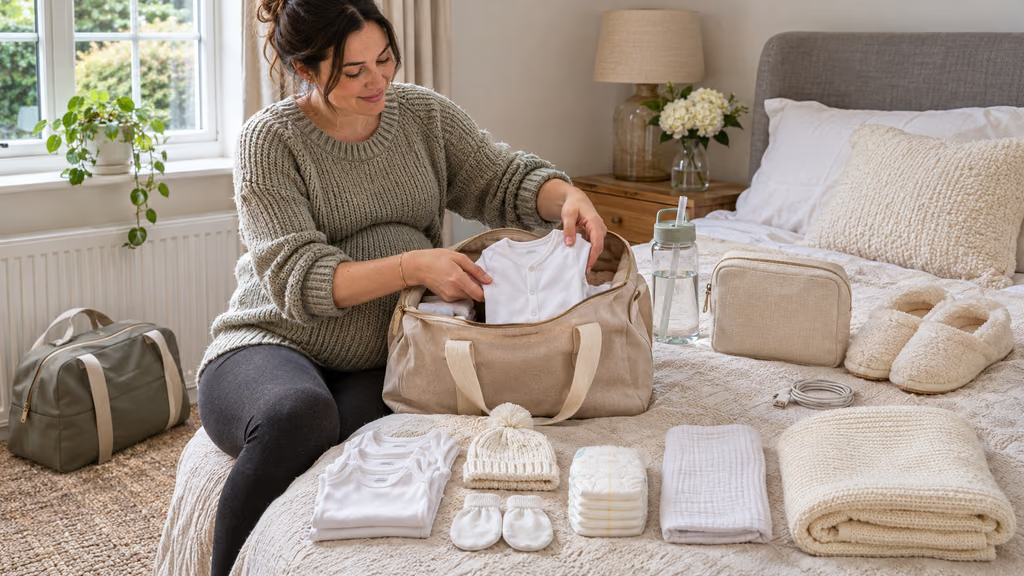
Babies come when they’re ready, and only about 1 in 20 arrives on the due date. That’s why the NHS suggests having your hospital bag packed at least three weeks before your due date, which is around 37 weeks. The one thing you can’t do without is your maternity notes, whether they’re digital notes on your phone or a paper copy.
It’s easier to pack a few separate bags than one giant holdall. A labour bag comes in with you, holds your baby’s first things and covers a straightforward birth, when you may be home within a day. A second bag waits in the car or by the door in case you’re moved to the postnatal ward, which is likely after a caesarean, and your birth partner packs their own.
Your hospital bag checklist, bag by bag
Each bag has its own job, so it helps to know where it waits and what it mustn’t be without.
Bag and where it waits | Don’t forget |
|---|---|
| Labour bag, by the door from 37 weeks | Maternity notes, birth plan, going-home clothes, snacks, phone charger |
| Baby’s things, in the labour bag | Vest, sleepsuit, hat, a few nappies, blanket |
| Partner’s bag, comes in with you | Change of clothes, food, phone charger, parking money |
| Postnatal bag, in the car or at home | Nightwear, knickers, maternity pads, more baby clothes |
| Going home | Car seat fitted in the car, going-home outfit, blanket, warm layer for outside |
Make sure your birth partner knows what’s in each bag and where it is, because they may be the one fetching things during labour or after the birth.
What to check with your maternity unit
What’s provided varies between NHS trusts, so a few questions to your midwife, or a look at your unit’s maternity pages, can save you packing the wrong things:
- Formula feeding: whether the unit supplies formula, bottles and teats, and whether it has anywhere to sterilise or make up powdered milk. Some don’t: Hull University Teaching Hospitals, for example, asks parents to bring ready-made first infant milk in starter packs with teats.
- Labour aids: whether there are birth balls, mats or a birth pool, and whether you’d need to hire your own TENS machine.
- Phone charging: whether you can charge a phone on the ward. Some units don’t allow it, so arrive fully charged with a battery pack.
- Parking: how the car park takes payment, so your birth partner isn’t hunting for change.
- Going home: how soon people usually go home after a straightforward birth, which tells you how much to pack for a longer stay.
What to pack in your hospital bag for labour
This bag comes in with you, and it should also see you home if you leave on the same day.
For you
- Maternity notes and birth plan. Digital notes live on your phone; if you have paper notes, they go in first.
- Something loose to labour in, such as an old nightdress or a big T-shirt you won’t mind getting messy. Pack two sets if you’re planning a water birth.
- Clothes to go home in. Choose something loose, as your tummy will still be rounded for a while.
- Two pairs of big, comfortable knickers. Disposable ones are handy.
- Dressing gown, slippers or flip-flops, and warm socks.
- A few maternity pads, which also help if your waters break.
- A comfortable or nursing bra and a few breast pads, however you plan to feed.
- Snacks and drinks to keep your energy up, and a water bottle with a straw.
- A flannel, fan or water spray to keep cool, and lip balm for dry lips.
- Hair bands or clips.
- Your phone, a long charging cable or battery pack, and a written list of important numbers in case the battery runs out.
- Any medicines you take, and spare glasses or contact lenses.
- Your own pillow, if it would help you feel at home.
- Music, headphones, a book or podcasts for the slow parts.
- A TENS machine with spare batteries, if you plan to use one. It’s usually switched on before you leave home.
Toiletries for your hospital bag
A small wash bag covers labour and a short stay:
- Toothbrush, toothpaste and deodorant
- Hairbrush and flannel
- Soap or shower gel, unscented if your skin is sensitive after the birth
- Body lotion and hand sanitiser
- A towel
Your birth partner’s bag
Whether it’s your partner, your baby’s dad, a friend or your own mum, your birth partner will be more help if they can stay put through a long labour:
- A copy of the birth plan
- A change of clothes, because hospitals can be hot, and swimwear if they’ll be getting into a birth pool with you
- Toothbrush, toothpaste and deodorant
- Their own snacks and drinks, so they don’t need to leave you
- A fully charged phone and charger
- Any medicines they take, and spare glasses or contact lenses
- Change or cash for the car park and vending machines
- A blanket or mat in case they get the chance to sleep
- A notebook or notes app for the midwives’ names, what happened when, the support ideas you agreed and who to tell once the baby arrives
If you stay in: your postnatal bag
After a straightforward birth you may go home from the labour ward within hours, or you may be moved to a postnatal ward for a day or two. This bag covers the second case. Leave it in the car or ready at home for someone to bring in, so you aren’t carrying it all through labour.
- Front-opening or loose nightwear. It makes breastfeeding easier, and a nightie makes it simpler to change maternity pads and for a midwife to check any stitches.
- Three changes of comfortable clothes.
- Three or four more pairs of knickers: disposable ones, or old cotton pairs you’re happy to throw away.
- Two packs of super-absorbent maternity pads.
- One or two more bras, including nursing bras if you plan to breastfeed, and more breast pads.
- An eye mask and earplugs, because postnatal wards can be bright and noisy.
- More snacks and drinks.
- A bag for dirty washing.
- A small present “from the baby” if an older brother or sister will be visiting.
Packing for a caesarean
For a planned caesarean (C-section) you can leave out the labour clothes and labour aids, but bring the postnatal bag with you: most women stay in hospital for 1 or 2 days after a caesarean. If you’re hoping for a vaginal birth, having that bag ready in the car also covers you if you end up with an unplanned caesarean. Add:
- Two or three pairs of full-brief knickers that sit above the wound, or disposable ones, which are easier on the scar. The NHS advises loose, comfortable clothes and cotton underwear while the wound heals.
- Maternity pads: you’ll still have some vaginal bleeding, and the NHS advises using pads rather than tampons.
- Chewing gum, which can help with trapped wind after the operation, and dried fruit to help get your digestion going again.
- Your phone, a long charging cable, drinks and snacks within reach of the bed, as a catheter usually stays in for at least the first 12 hours.
You won’t be able to drive for a few weeks afterwards, so arrange who will take you home and check they know how to fit the car seat.
Newborn hospital bag checklist
Your baby needs less than you might think for the first day or two. Put a first outfit and a few nappies in the labour bag and the rest in the postnatal bag:
- Three vests or bodysuits and three sleepsuits, plus a cardigan
- An outfit to go home in, with a hat, scratch mittens and socks or booties
- A small pack of newborn nappies: 6 to 8 should cover the first couple of days
- Cotton wool, or baby wipes without alcohol or fragrance
- A couple of muslin squares
- A blanket or shawl
- A snowsuit or pramsuit for outside if it’s cold, but read the car seat advice below first
- If you’ve decided to formula feed, ready-made first infant milk in starter packs with teats, unless your unit has told you it provides them
Expecting twins? Double the baby list and plan a car seat for each baby. For stocking up at home, our guide to how many nappies a newborn uses a day helps you work out how many packs to buy.
Getting your baby home safely
If you’re going home by car, your baby needs to travel in a rear-facing baby car seat, however short the drive. The Lullaby Trust calls a rear-facing seat essential for safety, so sort it out before your due date:
- Fit it and practise. Fit the seat following its instructions, then practise putting a teddy in it and fitting it in the car, as Hull’s NHS trust suggests. Many shops will help with fitting.
- Mind the airbag. If the seat has to go in the front, the front airbag must be switched off before you fit a rear-facing seat.
- Check the seat suits your baby. It needs to be right for their weight or height, and it’s best not to use a second-hand seat whose history you don’t know. Our pick of baby car seats from birth and our guide to checking whether a car seat is really safe cover both.
- Get the harness right. In a rear-facing seat, the top of the harness sits about 2 cm below your baby’s shoulders. It should be snug enough that only one or two fingers fit between the harness and their chest, with the buckle off their tummy.
Dressing your baby for a winter trip home
The NHS list suggests a snowsuit if it’s cold, and that’s right for the walk to the car. It shouldn’t be worn under the harness, though: thick padding stops the straps fitting snugly, and The Lullaby Trust advises taking snowsuits, coats and hats off once your baby is in the car so they don’t overheat.
If your baby goes home in an infant carrier, strap them in on the ward in thin layers, such as a vest, sleepsuit and cardigan, check the harness, then tuck a blanket over the top for the walk out. A hat is fine outside but comes off in the car. With a seat that stays in the car, carry your baby out in the snowsuit or wrapped in a blanket, take it off in the car, buckle up, then lay it over them. Either way, fold back the top layer once the car has warmed up. Our guide to what babies can wear under a car seat harness has a quick test for bulky clothes.
It’s fine if your baby falls asleep on the way, but take them out of the car seat when you get home and lay them on a firm, flat surface to sleep. The Lullaby Trust also advises avoiding long drives with very young or premature babies, and taking regular breaks if you can’t.
Going home by bus, train or on foot? Bring a pushchair, or a sling or carrier that suits a newborn. Our guide to choosing a baby carrier or sling explains how to check the fit.
Hospital bag FAQs
References:
- NHS Best Start in Life: Hospital bag checklist
- NCT: Hospital bag checklist: what do I need?
- Hull University Teaching Hospitals NHS Trust: What to pack in your hospital bag
- NHS: Caesarean section recovery
- NHS: Where to give birth: the options
- GOV.UK: Child car seats: the law
- RoSPA Child Car Seats: Using child car seats
- The Lullaby Trust: Car seats


