
Newborn essentials list: what you actually need, and when
Your newborn essentials list can be short: a safe place to sleep, a car seat, feeding and changing kit and a few clothes. What to buy first, and what can wait.
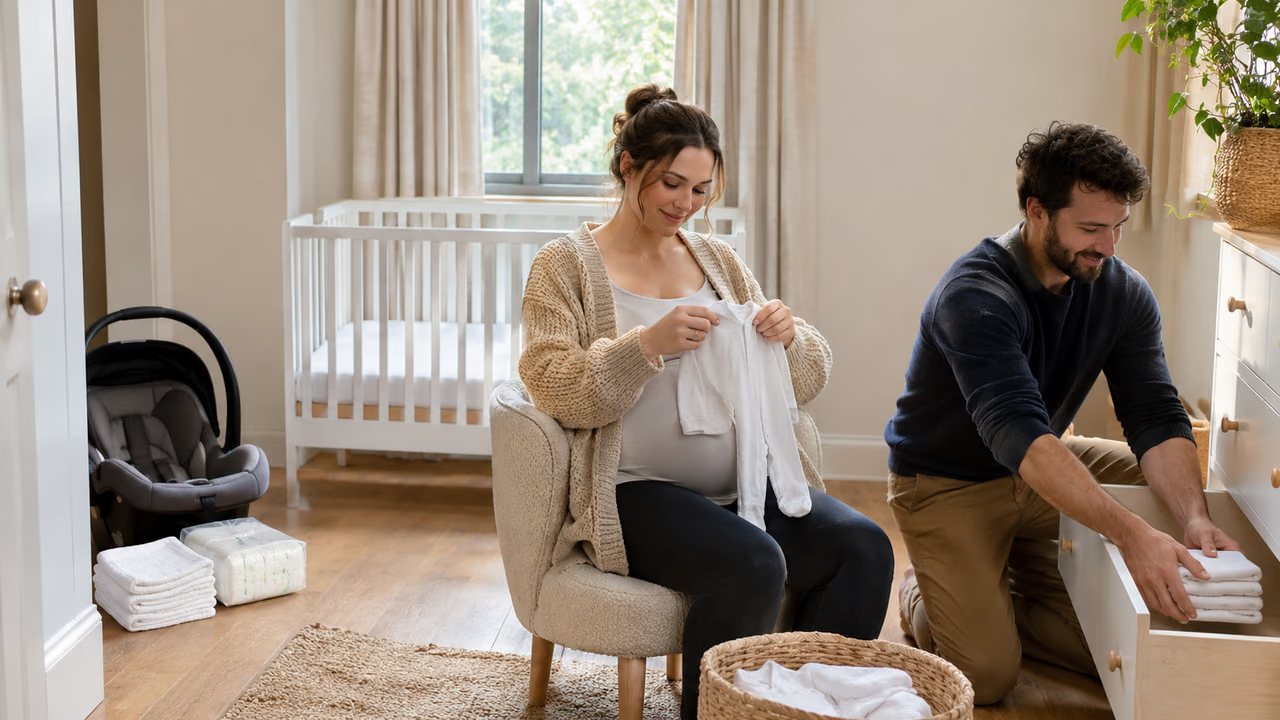
Baby essentials checklists can make it feel as if you need a nursery full of kit before the birth. You don't. The NHS suggests starting with the essentials and adding things as you need them, and The Lullaby Trust says safer sleep takes only a few simple items. The things you need for a newborn in the first weeks come down to somewhere safe to sleep, a car seat if you drive, milk, nappies and enough clothes to stay warm and clean.
What else you need, and when, depends on how you plan to feed, whether you drive and how much space you have. Plenty of it can come from friends, family or nearly new sales: the NHS says nothing needs to be brand new except the cot mattress and the car seat.
What you need before your baby arrives
Here's the newborn checklist of must-haves, grouped by what each item is for. The graphic shows how the whole list falls into place over your baby's first months:

Somewhere safe to sleep
For the first few months, a Moses basket, crib or carrycot is enough. Your baby should sleep on their back in their own clear, flat sleep space, and The Lullaby Trust recommends keeping it in the same room as you, day and night, for at least the first six months, so measure the space beside your bed before you choose. Our guides to Moses baskets and bedside cribs compare the options.
You'll also need:
- a firm, flat, waterproof mattress that fits snugly, with no gaps round the edges
- at least 4 fitted sheets, because they need changing often
- 2 baby sleeping bags, or sheets and light blankets tucked in firmly below your baby's shoulders
- a room thermometer, to keep the room at the 16 to 20°C The Lullaby Trust recommends
Look for the British Standard on the label: BS EN 1466 for Moses baskets and carrycots, BS EN 1130 for bedside cribs and BS EN 716 for cots. If you go for sleeping bags, our guide to TOG ratings shows which weight suits your baby's room.
A car seat for the journey home
If you have a car, your baby must travel in a car seat on every journey, starting with the drive home from hospital. You need a rear-facing infant seat approved for use in the UK: look for the E mark with R129 (i-Size) or ECE R44 on the label. Fit it before your due date, and never put a rear-facing seat in a front seat with an active airbag.
Car seats are for travelling, not for sleep at home. If your baby nods off on the way, lift them out and lay them on a firm, flat surface once you arrive. Our pick of baby car seats from birth compares infant carriers and seats that last longer, and our hospital bag checklist covers fitting the seat and dressing your baby for the trip home.
Feeding kit for breast or bottle
What you need depends on how you plan to feed, and you can add to it once you've started.
If you're breastfeeding
- nursing bras: get measured at around 36 to 38 weeks of pregnancy
- breast pads and nipple cream
- muslin squares for burping
A breast pump is on the NHS list, but you can also express by hand, and your midwife or health visitor can tell you about hiring an electric pump. If you're not sure you'll express regularly, it can wait; our pick of electric breast pumps is there when you need one.
Breastfed babies need a daily vitamin D supplement from birth, 8.5 to 10 micrograms, even if you take one yourself. The drops are free if you qualify for Healthy Start.
If you're formula feeding
- bottles with teats and caps
- a steriliser: cold-water, microwave or electric steam
- a bottle brush and a teat brush
- first infant formula, as powder or ready-to-feed liquid
- muslin squares for burping
Bottles, teats and the rest of the feeding kit need sterilising until your baby is at least 12 months old, so choose a steriliser that suits your kitchen and routine. Our guides to choosing a baby bottle and teat and bottle sterilisers help with both. Babies who have more than 500ml of formula a day shouldn't be given vitamin drops, because formula is already fortified with vitamin D.
Nappy changing, bath time and health basics
For changing, you'll need:
- newborn nappies, disposable or cloth
- cotton wool and warm water, or fragrance-free, alcohol-free baby wipes
- a changing mat or towel
- barrier cream to protect your baby's skin
- nappy bags or a bucket for dirty nappies
The NHS says the best place to change a nappy is on a mat or towel on the floor, where your baby can't fall, so a changing table is a nice extra rather than a must. If you do use one, keep your eyes on your baby the whole time and never turn away: the straps alone won't keep them safe. Our changing mats comparison includes wipe-clean and raised-edge mats.
For washing, a baby bath or a clean washing-up bowl, 2 towels and cotton wool are all you need. A newborn doesn't need a bath every day: in between, you can top and tail, washing their face, neck, hands and bottom. Plain water is fine, or a liquid cleanser made for babies, and you can check the water with your wrist or elbow. Our guide to baby bath temperature explains how warm it should be, and our baby baths pick helps if you'd like a dedicated bath.
The health basics are short:
- a digital thermometer, which the NHS says to use under the arm for children under 5; forehead strips only measure skin temperature (our thermometer picks)
- baby nail clippers or small round-ended scissors
- vitamin D drops, if you're breastfeeding
Getting out and about
At first your baby needs to lie flat when you're out: the NHS says a pushchair only suits a young baby if its seat reclines fully. That means a pram, a carrycot on a frame, a travel system with a carrycot or a pushchair whose seat lies fully flat. Before you buy, check the brakes, the handle height and the frame, and choose something light if you'll be lifting it onto buses or trains.
Add a blanket or shawl to wrap your baby in and a bag for nappies and spare clothes. A sling or carrier is optional. If you use one, keep to the T.I.C.K.S. rules: tight, in view, close enough to kiss, keep the chin off the chest and a supported back. Our guide to choosing a baby carrier or sling explains how to get the fit right.
How many clothes and nappies does a newborn need?
Babies grow quickly, so buy for the first few weeks rather than the first few months. These amounts come from the NHS lists:
What | How many |
|---|---|
| Sleepsuits | At least 6, for day and night |
| Vests or bodysuits | 4 to 6, with poppers under the nappy |
| Cardigans | 2, in wool or cotton rather than nylon |
| Fitted sheets | At least 4, as they need changing often |
| Nappies | Up to 10 to 12 a day, or 70 to 84 a week |
Round it off with scratch mittens, socks or booties, a hat for going out (a sun hat in summer, wool or cotton when it's cold) and a snowsuit for cold weather. Babies don't need hats indoors. Take the snowsuit and hat off once your baby is in the car, so they don't overheat; our guide to coats in car seats explains why padding also gets in the way of the harness.
For nappies, start with a few packs of newborn size and check the fit before you buy in bulk. Our guide to how many nappies a newborn uses turns those daily numbers into packs, and our nappy comparison helps once you know which size and shape fit.
You don't need a special baby washing powder either. The NHS says there's no evidence that bio powders or fabric conditioners irritate a baby's skin. The one exception is cloth nappies: fabric conditioner makes them less absorbent, so leave it out of the nappy wash.
What can wait, and what to leave off the list
Things that can wait a few months
- A cot or cot bed. A Moses basket or crib in your room is enough at first. You'll need a full-size cot once your baby outgrows it, so check the weight or age limit in its instructions. Cot beds last into the toddler years.
- A high chair and weaning kit. Solid foods start at around 6 months, and that's when you'll want a high chair with a harness, soft spoons, a bowl, bibs and an open or free-flow cup. Our guide to choosing a high chair explains what to look for.
- Stair gates. Fit them at the top and bottom of the stairs once your baby starts crawling, and look for BS EN 1930:2011 on the label. Our guide to choosing a stair gate starts with where it has to go.
- A baby monitor. While your baby sleeps in your room, day and night, you're close enough to hear them. A baby monitor earns its place once they sleep in a room of their own.
- A breast pump, until you know you'll be expressing regularly.
Sleep products to leave off the list
Some products sold for babies to sleep in aren't safe for it. The Lullaby Trust advises against:
- soft-sided pods and nests (why a nest isn't a safe place to sleep)
- pillows, duvets and thick, heavy bedding
- cot bumpers
- sleep positioners
- baby hammocks and bean bags
Bouncers and swings are for awake time, and a bouncer belongs on the floor, never on a table or worktop. If your baby falls asleep in one, move them onto their back in their cot or Moses basket. Away from sleep, skip baby bath seats too: RoSPA recommends not using them, because they can come away from the bath.
Second-hand or new, and help with the cost
Friends, family and nearly new sales, such as the NCT's, can cover a lot of this list, from clothes to prams. The Lullaby Trust recommends making sure any second-hand sleep product meets the relevant British Standard, especially if you're buying online.
Buy these new if you can
- Car seat. Ideally new. Only take a used seat from family or friends who can tell you it has never been in an accident and isn't too old, and never buy one from a second-hand shop or classified ads. Our guide to checking whether a car seat is safe covers labels, recalls and second-hand risks.
- Cot mattress. Ideally new for each baby. If you reuse one, it has to be firm, flat, clean, dry, waterproof, free of rips and a snug fit with no gaps, with a label showing it's fire-resistant. Our pick of cot mattresses covers the two standard cot sizes.
What to check on second-hand kit
- Cots and travel cots: BS EN 716, bars no more than 6.5cm apart, a sturdy frame and moving parts that can't trap fingers or clothes.
- Bedside cribs: BS EN 1130:2019, the standard all bedside cribs should meet since 2020, so check the label on an older crib.
- Moses baskets and carrycots: BS EN 1466, ideally with a new mattress.
- Prams and pushchairs: brakes that work, a strong frame and a seat that lies flat.
Help with the cost
- Scotland's Baby Box. Every newborn in Scotland can get one. Your midwife registers you at your 18 to 20-week or 28-week appointment, and the box arrives in the 4 weeks before your due date. It includes clothes from newborn to 6 months, a mattress with a protector and 2 fitted sheets, a changing mat, a bath towel, a digital under-arm thermometer, a bath and room thermometer and books, so wait for it before buying those.
- Sure Start Maternity Grant (England, Wales and Northern Ireland): a one-off £500 if you're expecting your first child, or twins or more when you already have children, and you or your partner get Universal Credit, Pension Credit or income-related Employment and Support Allowance. Claim from 11 weeks before your due date until your baby is 6 months old.
- Pregnancy and Baby Payment (Scotland): £796.65 for your first child and £398.35 for later children, from 24 weeks of pregnancy until your baby is 6 months old. You or your partner normally need to get a benefit such as Universal Credit, Housing Benefit or Pension Credit; under-18s can apply without one.
- Healthy Start: if you qualify, your baby's vitamin drops are free. Our Healthy Start guide explains who can get it and what else it pays for.
Newborn essentials: common questions
References:
- NHS Best Start in Life: What to buy for your newborn baby
- NHS: What you'll need for your baby
- The Lullaby Trust: Baby sleeping products
- The Lullaby Trust: Your baby's room temperature
- The Lullaby Trust: Car seats
- GOV.UK: Child car seats, the law
- NHS: Vitamins for children
- NHS: Sterilising baby bottles
- NHS: How to change your baby's nappy
- NHS: Washing and bathing your baby
- mygov.scot: Scotland's Baby Boxes
- GOV.UK: Sure Start Maternity Grant
- mygov.scot: Best Start Grant and Best Start Foods


